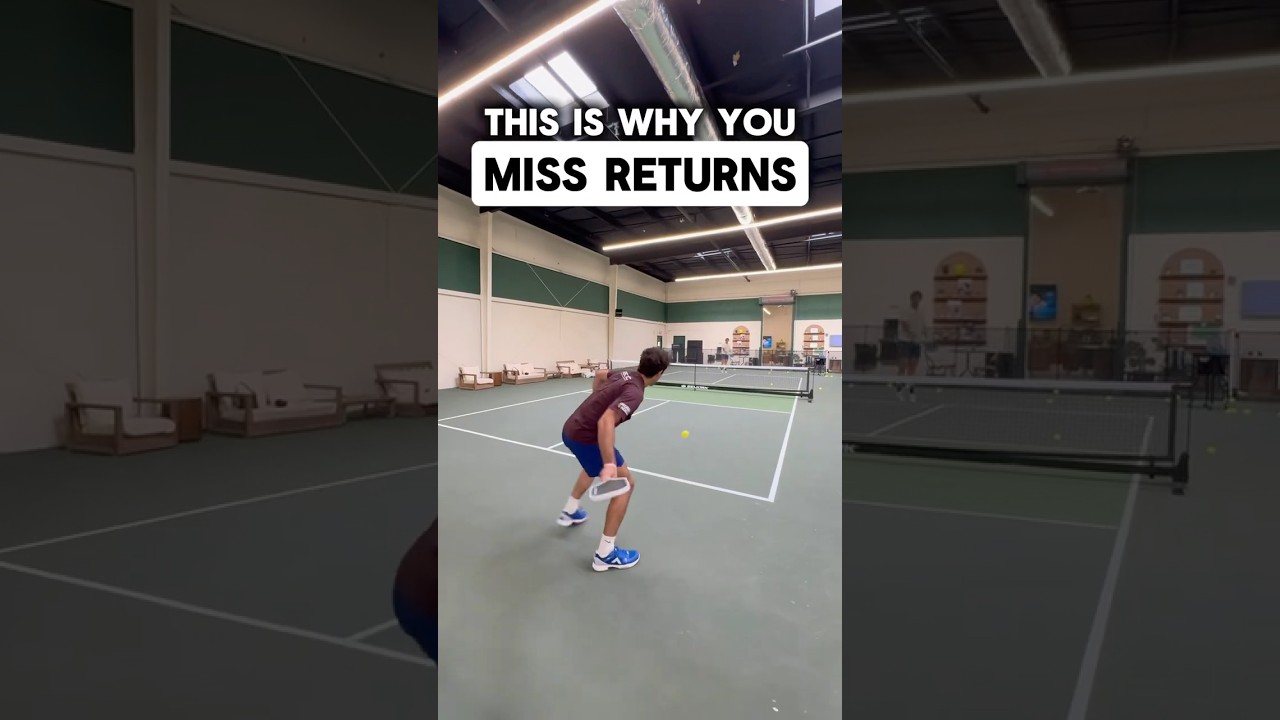
If your pickleball return keeps flying long, the problem is probably your backswing, not your footwork. Here is the simple adjustment that fixes it fast.
If your pickleball return keeps sailing past the baseline, you are probably doing what most players do wrong: swinging harder when your opponent hits harder.
This fix comes from Richard Pickleball on YouTube, and it is one of the most counterintuitive corrections in the game.
Once you understand it, missing long on returns will become rare.
Love pickleball? Then you ll love our free newsletter . We send the latest news, tips, and highlights for free each week.
The Real Reason Your Returns Are Going Long
Most players assume that when they miss long on a return, they need to aim shorter or swing softer. That is only partially true.
The deeper issue is that your backswing is adding power you do not need , especially when the ball is already coming in hot.
When your opponent serves with pace, that incoming ball already carries energy.
The result is a return that launches off your paddle with way more speed than you intended.
This is a physics problem, not a technique problem. And the fix is not to try harder. It is to do less.
Why Do Big Serves Make the Problem Worse?
As you improve, you will face bigger serves. Faster pace, heavier spin, deeper placement.
Many players respond by tightening their grip , stepping back, or trying to time a longer swing.
All of those responses make the miss-long problem worse.
The truth is, a powerful incoming serve is actually an opportunity . You can redirect that energy without adding any of your own.
The ball will still travel deep into the court, because the server already did the work for you.
The ball bounces off. Your paddle can work the same way when you stop overswinging on the return.
If you want to understand why your serve keeps getting attacked , this same principle applies in reverse.
Pace without control is exploitable from either side of the net.
The Compact Return: How to Actually Do It
Eliminate the backswing entirely. That is the core adjustment.
Instead of pulling your paddle back behind your hip and swinging through, you start your paddle in a neutral, ready position and simply guide the ball forward.
Here is how to build this into your game:
Start with your paddle in front of your body , roughly at chest height, slightly forward of your torso. This is your ready position on the return.
Watch the ball off the paddle on the serve. Track it early so you can set your feet and avoid reaching or lunging.
As the ball arrives, guide it forward with a short forward push. No backswing, no full follow-through. Just a compact, controlled redirect.
Let the incoming pace carry the ball deep. Trust that the server s power is doing the work for you. You are just steering.
Keep your grip pressure medium to light. A death grip on the paddle transfers tension into the shot and causes pop-outs and long balls.
This is not a passive technique. You are still placing the ball with intention. You are just not adding unnecessary swing energy on top of what is already there.
For more on how to handle hard shots in pickleball , there are three distinct methods worth knowing. The compact return is one of them.
What Happens to Your Consistency When You Drop the Backswing?
Your return becomes dramatically more consistent. This is the part that surprises most players the first time they try it.
A shorter swing has fewer moving parts. Fewer moving parts means fewer things that can go wrong.
When you eliminate the backswing , you remove timing issues, over-rotation, and the off-center contact that causes errant returns.
A short, controlled guide stroke holds up because there is almost nothing to it.
This is why unforced errors in pickleball so often trace back to swing mechanics rather than strategy. You are not making a bad decision.
You are making a technically correct decision with too much physical input.
Does This Work on Slow Serves Too?
Yes, but with one adjustment.
On a slow serve, you do not have incoming pace to redirect, so you will need to add a small amount of controlled forward drive with your arm to ensure the return reaches the baseline.
Here is how to tell if your opponent s serve is fast enough for a pure compact return:
If the ball reaches you in under one second after leaving their paddle, you have plenty of pace to redirect.
If the ball arcs high and slow and lands around the kitchen line or mid-court, you will need to add a bit of your own power.
When in doubt, err toward less swing. A short return that lands in the court is always better than a long return that gifts your opponent a free point.
Understanding the keys to a pickleball return that creates offense starts with keeping the ball in play first.
You cannot create offense with a return that misses long.
Is Hitting Long on Returns Really That Costly?
Yes, missing a return long is one of the most expensive mistakes you can make.