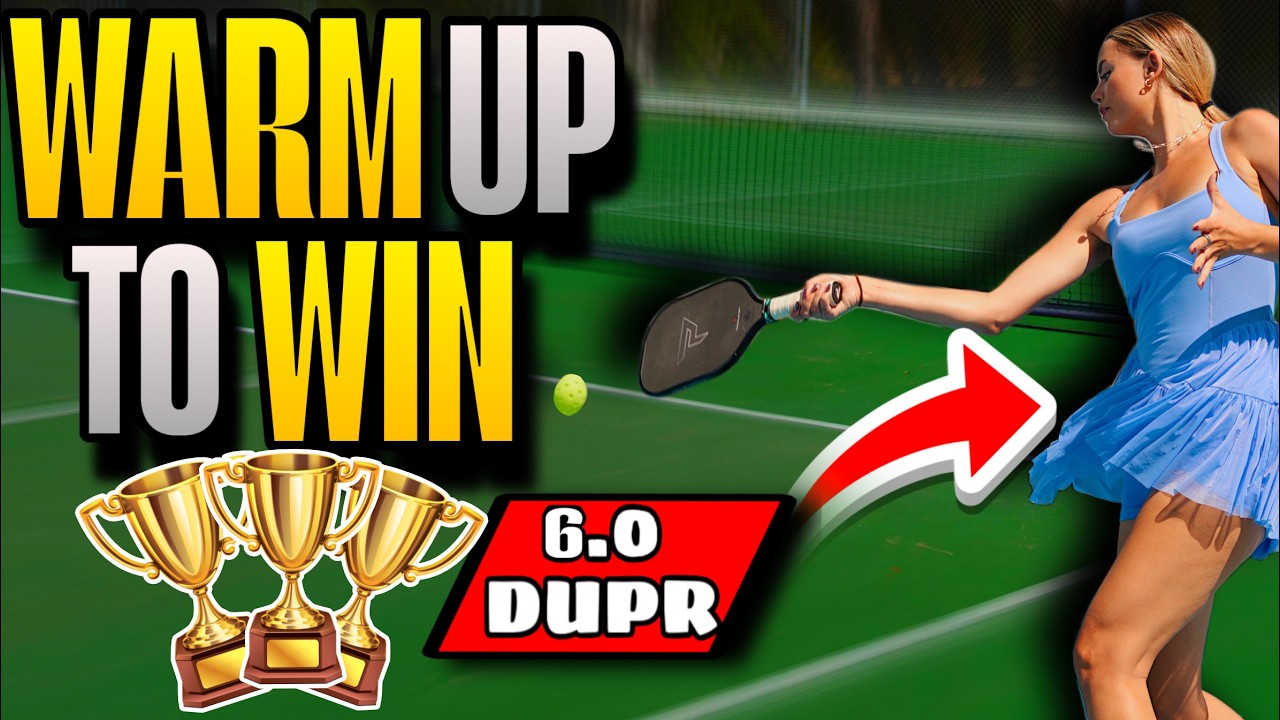
Most players show up, grab a paddle, and wonder why their first few games feel rough. This 3-step pickleball warm up routine fixes that before you even start the first rally.
A good pickleball warm up is the difference between feeling locked in from the first dink and spending two games shaking off rust.
Most players skip straight to hitting, maybe do a few casual rallies, and wonder why their drops are floaty and their resets keep popping up.
This pickleball warm up routine comes from Ava Ignatowich on YouTube , a PPA Tour professional who treats warming up as non-negotiable.
Get all three right and you will play better immediately .
Love pickleball? Then you ll love our free newsletter . We send the latest news, tips, and highlights for free each week.
Why Most Pickleball Warm Ups Fail
Showing up five minutes early and hitting a few slow dinks is not a warm up. It s a ritual that makes you feel prepared without actually preparing anything.
Your forearms and wrists have not been primed to absorb a hard speed up. And your touch on soft shots takes repetitions to find, not seconds.
The pickleball warm up framework here solves all three of those problems in a specific order.
Skip any step and you re leaving performance on the court.
Step 1: Warm Up Your Physical Body (Ground Up)
Always start from the ground and work your way up.
Your feet, ankles, and calves take the most abuse during lateral movement and split steps , so they need the most attention.
Here is the exact sequence to follow:
Ankle circles: Lean against a fence or wall, extend one foot, and circle the ankle in both directions about 10 times each. Repeat on both feet.
Calf raises in three positions: Feet neutral, toes pointed inward (pigeon toe), then toes pointed outward. About 10 reps in each position.
Toe heel walks: Walk heel to toe, back and forth, to warm up the full length of the foot.
Knee circles (stanky leg): Roll out the knees in both directions before loading them with squats.
Assisted squats: Hold the net or a fence for balance and drop into a squat with a few pulses. Stand and repeat.
Leg swings: Side to side and front to back, both legs. This is your hip mobility work.
World s greatest stretch: Step into a deep lunge position and rotate each side. Get as low as your body allows.
Walking lunges with rotation: Add a torso turn at the bottom of each lunge. Then do lateral side lunges.
Hamstring sweeps: Point your toe up, sweep the ground, step forward, and repeat.
Knee to chest walks: Pull each knee up with both hands while you walk forward.
Spine mobility: Standing cat cow. Arch your back, then round your spine. Do this standing if lying on a hot court isn t practical.
Wrist and forearm circles: Circle your wrists in both directions, then flex the wrist down and up repeatedly to prime the forearm tendons.
Arm circles and shoulder loosening: Large backward arm circles, then move into whatever shoulder rotation feels right. This is the area players underestimate most.
If you only have time for one step, this is the one to prioritize. Injury prevention in pickleball starts before you ever step onto the court.
The forearm and wrist section deserves extra attention. Pickleball puts repetitive stress on that area and players chronically skip it.
Thirty seconds of wrist circles costs you nothing.
What Does Warming Up Your Touch Actually Mean?
Touch refers to your feel on soft game shots.
Drops, resets, and dinks all require the same fundamental skill: a soft, controlled paddle face that absorbs pace rather than redirecting it.
You need repetitions, not just time.
When you train it, your dinks naturally feel softer because you ve raised your baseline feel.
If you want to understand why resets keep failing for most players, this breakdown on why your reset keeps popping up is worth reading before your next session.
Step 2: Warm Up Your Touch the Right Way
Do not warm up your drops stationary. This is the mistake almost every intermediate player makes.
In a real game, you are hitting your third shot drop while moving forward toward the kitchen.
Instead, use a moving drop and reset drill:
Start at the baseline and drop the ball toward the kitchen while moving forward.
Your partner meets the ball at the kitchen line and resets or counters it.
You move back, repeat, and work both directions continuously.
This is similar to the slinky drill, where you move back and forward in rhythm with your partner.
The movement makes every rep more specific to what you ll actually face in a point.
There is nothing worse than getting a perfect setup in game one and shanking the overhead into the fence because you never warmed up aggressive swings.
Have your partner feed you attackable balls during the drop and reset drill and actually try to finish them.
This also warms up your partner s defense, which makes the whole drill more realistic. They might be mildly annoyed for thirty seconds. They ll play better for it.