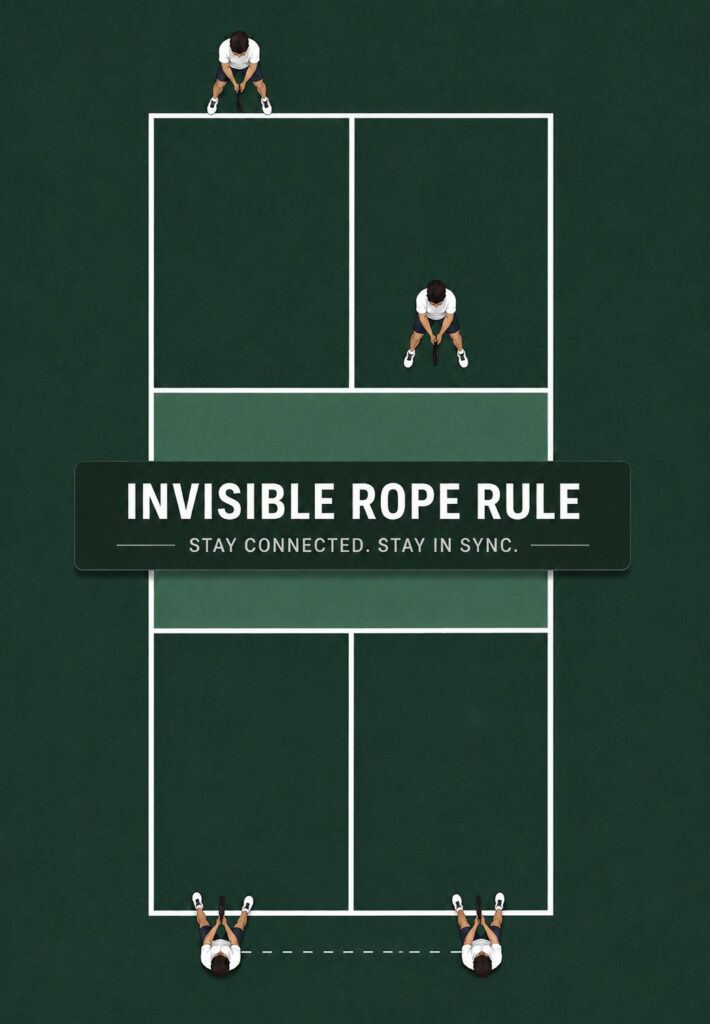
The six-foot rope is a great beginner rule, but advanced doubles players know when to let it stretch . Move with your partner without copying every step, protect the opponent’s highest-percentage shot, and stay close enough to the middle to pressure the next ball instead of guarding out-of-bounds space.
If you’ve ever taken a pickleball lesson, you’ve probably heard this advice:
Imagine there’s a six-foot rope connecting you and your partner. When one player moves sideways, the other moves with them.
It’s one of the most useful beginner doubles concepts in pickleball. The imaginary rope keeps partners connected, closes dangerous gaps, and prevents two players from defending the court like separate singles competitors.
But popular pickleball coach Dayne Gingrich recently made an important clarification: the rope should not remain pulled tight through every kitchen exchange.
The mistake isn’t moving with your partner. The mistake is copying their movement so literally that you slide toward the sideline, protect balls that would already land out, and remove yourself as a threat in the middle.
The six-foot rope is a teaching tool—not a fixed measurement.
At higher levels, partners stay connected by protecting the opponent’s most realistic shots, not by maintaining exactly the same distance throughout every rally.
Why the Six-Foot Rope Works
The rope concept solves a common recreational doubles problem: partners drifting too far apart.
When one player follows a wide ball and the other stays planted, a large seam opens between them. The opponents can attack that gap, create confusion over ownership, or repeatedly force one player to cover too much court.
The rope teaches both players to respond when the ball moves:
Ball goes left, the team shifts left.
Ball goes right, the team shifts right.
One player gets pulled wide, the partner helps close the middle.
That foundation is correct. The problem begins when players assume both partners must move the same distance.
The Rope Should Stretch and Contract
Imagine your partner is on the left side and sends a sharp crosscourt dink . The opponent is pulled wide near the sideline.
Your partner naturally follows the ball and protects the immediate crosscourt exchange. You should also move—but probably not as far.
If you slide several feet toward your right sideline simply to preserve a perfect six-foot gap, you may end up guarding an extreme down-the-line shot that has very little court available. Much of the area beyond you is already out of bounds.
At the same time, you have moved away from the middle, reduced your ability to poach, and made the safest part of the court easier for your opponents to access.
The better movement is asymmetric:
The player closest to the ball moves more. The partner away from the ball moves less.
Think of the rope stretching slightly rather than staying rigid.
Stop Protecting Out-of-Bounds Space
This is the central idea behind Gingrich’s advice. You do not need to cover every possible ball.
From a severe crosscourt position, an opponent may technically be able to hit down the line past you. But the farther outside that target sits, the smaller their available court becomes.
If you move all the way over to remove that tiny lane, you may be sacrificing the middle to protect a low-percentage shot.
A smarter defender concedes part of the extreme sideline while protecting the more likely ball just inside it.
That doesn’t mean leaving the line completely open. It means understanding where the playable line ends and where out-of-bounds space begins.
A useful question is:
Am I protecting the court—or am I protecting the fence?
If your position primarily guards a ball that would land outside the sideline, you have shifted too far.
If you d rather watch than read, the short Instagram video below features pickleball coach Dayne Gingrich explaining this concept. He shows why blindly moving side to side with your partner can actually hurt your doubles positioning—and what you should do instead.
Your Middle Presence Is an Offensive Weapon
Staying closer to the middle is not only about defense. It makes you a threat.
When the opponent across from your partner sees you near the seam, they know that a loose middle dink may be intercepted. That can influence their shot selection before they even make contact.
aim wider and accept more risk
avoid a comfortable middle target
rush a crosscourt redirect
contact the ball later
choose a softer, more predictable dink
You can pressure an opponent without touching the ball.
This is why the partner away from the action should not disappear toward the sideline. That player often has the best opportunity to attack a weak reply into the middle.
Think “Tilt,” Not “Slide”
A better image than the six-foot rope is a defensive unit that tilts toward the ball . When the ball moves wide:
the ball-side player protects the sharp angle and the line directly ahead;
the off-ball partner shades toward the rally;
the off-ball partner remains close enough to threaten the middle;