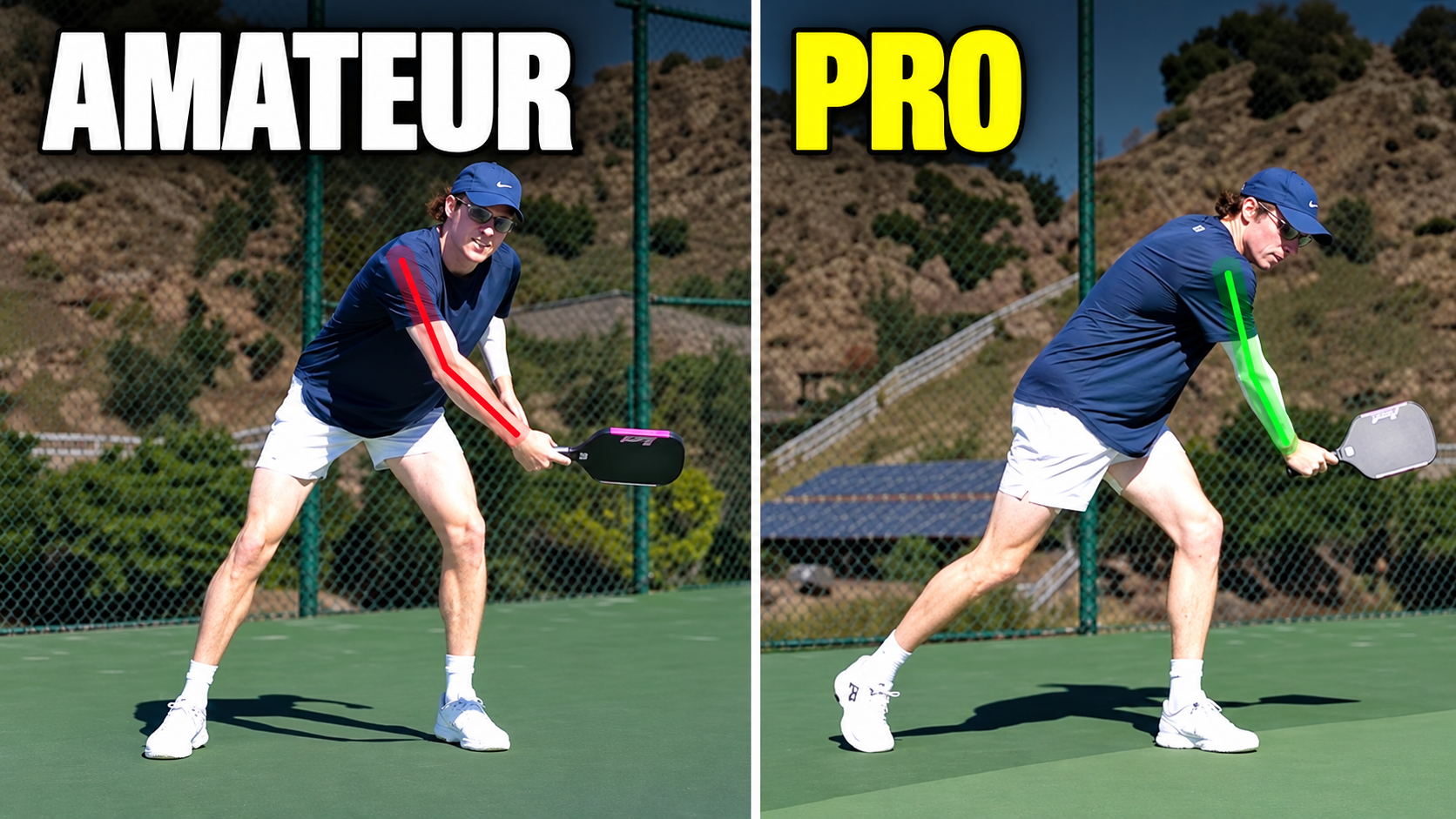
Pro pickleball dinking is not about keeping the ball low and hoping for a mistake. These five habits show you how the best players actually think and compete at the kitchen line.
Most rec players treat pickleball dinking like a waiting game. Keep it low, stay patient, and hope the other team messes up first.
That mindset will cap your game fast.
These five habits come from Roscoe Bellamy on YouTube, who breaks down the chess match happening at the net that most rec players never even notice.
Here is exactly what pros do differently and how you can start doing it too.
Love pickleball? Then you ll love our free newsletter . We send the latest news, tips, and highlights for free each week.
Habit 1: Getting Into Perfect Position Before Every Dink
This is the single biggest difference between a casual dink and an offensive pressure dink.
When you are in poor position, leaning and reaching for balls, you have almost no options. You are just trying to get the ball back.
You can attack, you can redirect, you can hit a pressure dink that actually does something.
The fix is simple but requires real commitment.
Stop reaching. Treat every single dink as an opportunity to create pressure, not just survive.
Most rec players never do this because they assume dinking is passive. It is not. Dinking with intention starts with your feet, not your paddle.
Habit 2: Using the Reset Dink When You re Out of Position
Here is a mistake that costs rec players points constantly. Your opponent hits a great pressure dink that pushes you off balance, and instead of neutralizing, you try to match their power and hit something offensive back. That ball goes up and they attack it.
The reset dink is the answer. It is a deliberately soft, dead ball aimed toward the middle of the court where your opponent has the least angle to work with.
The goal is not to win the point with that shot. The goal is to take away their next attack.
When you absorb the pressure and leave them a neutral ball , you flip the dynamic. Now you are back in position and they have nothing to work with.
Think of the reset dink as a shield, not a mistake. Here is how to execute it:
Drop your paddle tip down to create a soft, open face
Aim toward the middle of the court where angles are eliminated
Take all pace off the ball and let it die inside the non-volley zone
Recover immediately back to center position
This is closely related to what coaches call the reset drill approach, where the priority is neutralizing before creating.
You will stop giving away free attacks if you commit to this habit.
Are You Creating Pressure With Your Body After the Dink?
Hitting a good pressure dink is only half the job. What you do with your body immediately after that dink is where most rec players completely miss it.
When you hit a quality dink that lands tight and low, close the gap .
They are now looking at you creeping closer, which makes them rush. If they leave anything up, you are already in position to put it away.
The ball does not create all the pressure. You do. Your positioning at the kitchen line is a weapon just as much as any shot you hit.
Habit 3: Attacking the Middle as a Strategic Tool
Rec players dink to the wings almost exclusively.
Pros use the middle of the court as an active weapon, and there are three specific reasons why it works:
Confusion between opponents. A ball hit to the middle forces two players to decide in a fraction of a second who is taking it. That hesitation causes errors.
Reduced attacking angles. When your opponent is hitting from the middle, they can only attack your body or through the center. Hard shots to your wings will go wide. You can ignore those.
It opens the wings. Pull your opponents together toward the middle first, then push them wide with a pressure dink. They cannot cover both effectively.
The sequence is simple: middle dink to create compression, then redirect wide to punish the gap.
This is exactly how owning the middle creates real offensive opportunities instead of just hoping someone pops one up .
The players who understand that are the ones dictating rallies while everyone else is just reacting.
Does Playing Patient Actually Create Pressure?
Yes, and this might be the most counterintuitive thing on this entire list. Patience at the kitchen line is not passive. It is a form of pressure that builds over time.
When you consistently reset , stay neutral, and refuse to give your opponent anything easy, it forces them to take bigger risks.
The wrong mindset is thinking you need to force something aggressive on every exchange. The chess match at the kitchen line has a rhythm.
Rec players break this rhythm constantly because they feel uncomfortable just dinking.
They force attacks from bad positions and hand their opponents free points.
Learning to stay patient during a long rally is a skill that takes practice, but it changes how you compete entirely.
Habit 4: Reading When You Have an Advantage vs. When You Need to Neutralize
This is the meta-skill that ties all five habits together.